
Hydrodilatation for Frozen Shoulder: A Non-Surgical, Ultrasound-Guided Path Back to Mobility
How ultrasound-guided hydrodilatation with corticosteroid and dextrose-water solution treats adhesive capsulitis (frozen shoulder), the indications, the protocol, costs, and the role of physiotherapy at ReGenesis Longevity Clinic.
Few musculoskeletal conditions are as misunderstood — or as quietly disabling — as a frozen shoulder. What often begins as a vague, nagging ache evolves over weeks into a profound loss of motion, disrupted sleep, difficulty dressing, and an inability to perform the simplest overhead tasks. For many patients, the frustration is compounded by a long list of partial solutions: anti-inflammatories, generic stretching programs, isolated cortisone shots, and the recurring suggestion to "give it time." While adhesive capsulitis (the medical name for frozen shoulder) does eventually resolve in many cases, the natural course can take 18 to 36 months — a span of time most patients are not willing, and often not able, to tolerate.
Hydrodilatation is one of the most evidence-supported, non-surgical interventions for frozen shoulder. When performed under ultrasound guidance and integrated into a structured rehabilitation plan, it offers a precise, biologically grounded way to restore capsular volume, reduce pain, and accelerate the return of meaningful range of motion. At ReGenesis Longevity Clinic™, hydrodilatation is delivered as a focused, image-guided procedure using a corticosteroid and dextrose-with-water solution, supported by physiotherapy throughout the treatment phase to optimize the outcome.
What Is Hydrodilatation?
Hydrodilatation — sometimes spelled hydrodilation, and also referred to as capsular distension or shoulder distension arthrography — is a minimally invasive procedure in which a controlled volume of fluid is injected directly into the glenohumeral (shoulder) joint capsule. The goal is to mechanically stretch and distend the contracted, thickened capsule that defines adhesive capsulitis, while simultaneously delivering medication into the joint to address the inflammatory and fibrotic processes driving the disease.
At ReGenesis, the injectate is a combination of corticosteroid (used on the first visit only) and a dextrose-with-water solution that provides the volume needed to safely distend the joint capsule. The corticosteroid addresses the inflammatory component characteristic of the early and intermediate stages of frozen shoulder; the dextrose-water mixture provides the hydraulic pressure required to stretch the contracted capsule and, through gentle osmotic effects, may further support tissue remodeling. The procedure is performed entirely under ultrasound guidance to ensure the needle is positioned precisely within the joint and that the injectate distributes correctly along the capsule.
Why Ultrasound Guidance Matters
Hydrodilatation performed without imaging is essentially a blind injection into a deep, anatomically complex joint surrounded by tendons, nerves, and vessels. Accuracy of blind glenohumeral injections is poor — published rates of true intra-articular placement vary widely, and a misplaced injection cannot achieve capsular distension regardless of how skilled the operator may be. Ultrasound guidance allows the clinician to visualize the joint in real time, advance the needle directly into the capsule under continuous imaging, confirm intra-articular placement, and watch the capsule distend as the solution is delivered. This is what transforms hydrodilatation from a hopeful injection into a reproducible, precise procedure.
Understanding Frozen Shoulder (Adhesive Capsulitis)
Adhesive capsulitis is a condition in which the capsule surrounding the glenohumeral joint becomes inflamed, thickened, and progressively contracted. The result is a shoulder that is both painful and stiff, with loss of motion in all planes — particularly external rotation. The condition typically progresses through three overlapping stages: a painful ("freezing") phase, a stiff ("frozen") phase, and a gradual recovery ("thawing") phase. Without intervention, the entire course can last years, and a meaningful subset of patients are left with permanent residual loss of motion.
Who Develops Frozen Shoulder?
Frozen shoulder most commonly affects adults between the ages of 40 and 60 and occurs more frequently in women than in men. There is a strong association with diabetes, thyroid disease, and prior shoulder injury or immobilization. It can occur in one shoulder, then the other, and is occasionally bilateral simultaneously. While the precise cause remains incompletely understood, the underlying biology involves chronic inflammation, fibroblast proliferation, and excess collagen deposition within the joint capsule — a pathological remodeling process that hydrodilatation is well suited to interrupt.
How Hydrodilatation Works
Hydrodilatation works through three complementary mechanisms that, together, address the structural, inflammatory, and functional components of frozen shoulder.
1. Mechanical Capsular Distension
The most direct effect of hydrodilatation is hydraulic. As fluid is injected into the contracted capsule under controlled pressure, the capsule is gently stretched. In many cases, the operator and patient can identify the moment of capsular release, and post-procedure imaging often demonstrates increased intracapsular volume. This mechanical effect is what allows patients to begin regaining range of motion almost immediately, and what creates the window of opportunity for physiotherapy to consolidate those gains.
2. Anti-Inflammatory Effect of Corticosteroid
Adhesive capsulitis, particularly in its earlier stages, is driven by a chronic inflammatory process within the capsule. A single dose of intra-articular corticosteroid, delivered with the first hydrodilatation treatment, has been shown to meaningfully reduce capsular inflammation, decrease pain, and improve the patient's tolerance for rehabilitation. At ReGenesis, corticosteroid is intentionally used on the first visit only. Repeated corticosteroid exposure offers diminishing returns and can adversely affect surrounding tendon and cartilage tissue, which is why subsequent treatments use the dextrose-with-water solution alone for capsular distension.
3. Volume, Tissue Hydration, and Repeat Distension
The dextrose-with-water solution provides the volume necessary to achieve and maintain capsular distension. Beyond the simple mechanical effect, dextrose injections have a long track record in regenerative medicine for influencing the local healing environment, modulating fibroblast activity, and supporting connective tissue remodeling. By repeating the distension at one-month intervals, the capsule is given progressive opportunities to remodel into a more compliant, less restrictive structure.
Indications: When Hydrodilatation Is the Right Choice
Hydrodilatation is most effective when used at the right point in the disease and in a patient whose clinical picture is clearly consistent with adhesive capsulitis. Not every stiff or painful shoulder is a frozen shoulder, and accurate diagnosis is essential before recommending the procedure.
Confirmed Adhesive Capsulitis (Frozen Shoulder)
The clearest indication is a clinical and ultrasound diagnosis of adhesive capsulitis: a painful, progressively stiff shoulder with global loss of active and passive range of motion (especially external rotation), in the absence of structural pathology that would better explain the symptoms. Patients in the painful ("freezing") and stiff ("frozen") stages tend to derive the greatest benefit, although hydrodilatation can also be useful in the late stiff phase to accelerate recovery.
Frozen Shoulder Associated with Diabetes or Thyroid Disease
Patients with diabetes are particularly prone to frozen shoulder, and their clinical course is often longer, more painful, and more resistant to conservative measures alone. Hydrodilatation, combined with optimized metabolic control and structured physiotherapy, can shorten the disease course and reduce the risk of long-term residual stiffness in this population.
Post-Surgical or Post-Immobilization Stiffness with a Capsular Pattern
Some patients develop a frozen-shoulder-like presentation after a period of immobilization — for example, following rotator cuff surgery, a fracture, or prolonged sling use. When the clinical and ultrasound assessment confirms a capsular pattern of restriction, hydrodilatation can be a useful tool to restore motion, provided that any underlying surgical repair is sufficiently healed and the broader rehabilitation plan supports it.
When Hydrodilatation May Not Be Appropriate
Hydrodilatation is not the right choice for every stiff shoulder. Active joint infection, unstable fractures, large unrepaired rotator cuff tears, severe glenohumeral arthritis as the dominant problem, certain bleeding disorders, and uncontrolled diabetes with very high glucose levels are situations in which the procedure is either contraindicated or should be deferred. Patients whose primary problem is rotator cuff tendinopathy, subacromial impingement, calcific tendonitis, or cervical spine referred pain — rather than true adhesive capsulitis — will not benefit from capsular distension and require a different treatment plan. The role of the initial assessment is to make this distinction clearly and honestly.
What to Expect at ReGenesis
A hydrodilatation program at ReGenesis Longevity Clinic™ begins with a focused clinical assessment: history, physical examination, range-of-motion testing, review of any prior imaging, and a diagnostic ultrasound evaluation of the shoulder. This step is essential to confirm that adhesive capsulitis is the dominant problem and to identify any concurrent pathology that may need to be addressed alongside it.
The Procedure Itself
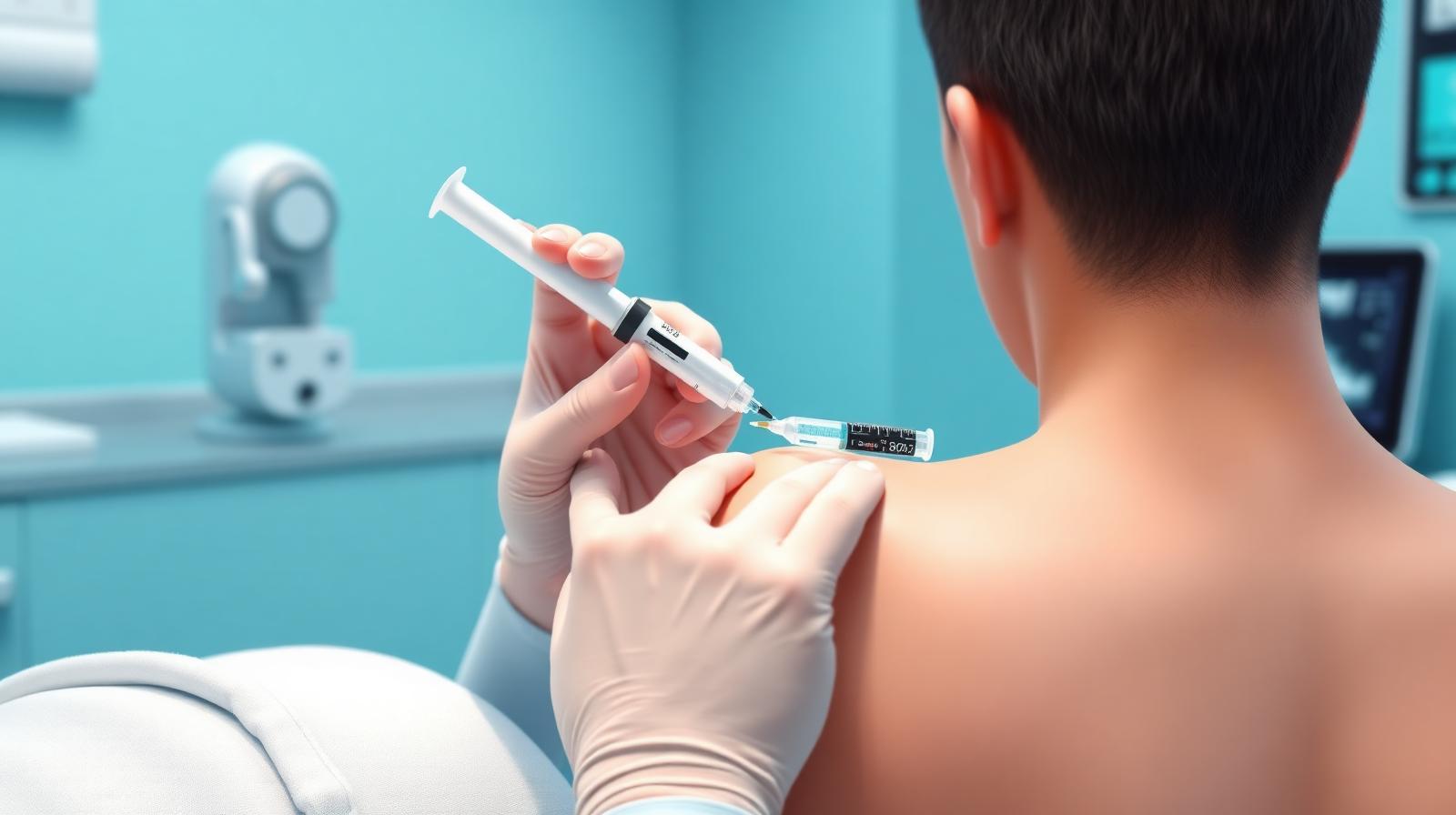
Each hydrodilatation visit takes approximately 30 to 45 minutes. The patient is positioned comfortably, the skin is cleaned, and a sterile field is established. Using high-frequency ultrasound, the glenohumeral joint is visualized in real time, and a fine needle is advanced under direct visualization into the joint capsule. On the first visit, a corticosteroid combined with the dextrose-with-water solution is delivered to distend the capsule and address the inflammatory component. On subsequent visits, the dextrose-with-water solution is used alone to repeat the capsular distension. Most patients describe the procedure as briefly uncomfortable rather than painful, and they walk out under their own power.
Treatment Series and Realistic Timelines
The full hydrodilatation program may require up to 3 treatments spaced at one-month intervals. The first treatment includes corticosteroid; the second and third (if needed) use the dextrose-with-water solution alone. Some patients respond meaningfully to a single treatment and do not require the full course; others, particularly those with diabetes or longer-standing stiffness, benefit from the complete three-visit series. Response is reassessed at each visit and the plan is adjusted accordingly. Meaningful improvement in pain and motion is often appreciated within days to weeks of the first treatment, with continued gains over the following months as the capsule remodels and rehabilitation progresses.
Cost of Treatment
At ReGenesis Longevity Clinic™, ultrasound-guided hydrodilatation is offered at $300 per treatment. Prices are subject to change. The total cost of a complete program will depend on how many of the up-to-three treatments are required, which is determined collaboratively with the patient based on response after each visit.
The Critical Role of Physiotherapy
Physiotherapy is encouraged throughout the treatment phase to optimize the outcome. Hydrodilatation creates a window of opportunity — a temporarily larger, less restrictive capsule and a less painful joint — but it does not, on its own, restore strength, motor control, or functional range of motion. That work belongs to a structured rehabilitation program.
An effective physiotherapy program after hydrodilatation typically focuses on progressive range-of-motion work in all planes (with particular attention to external rotation), graded capsular stretching, scapular stabilization, gentle progressive resistance training as motion improves, and patient education about activity modification, posture, and load management. Early, consistent engagement with physiotherapy is one of the strongest predictors of a good outcome, and patients who delay rehabilitation often see partial gains erode in the weeks following the procedure. At ReGenesis, we work alongside our patients' physiotherapists to align the timing of treatments with the rehabilitation plan and to ensure that each hydrodilatation builds on the gains of the previous one.
After the Procedure: What Patients Should Know
Mild post-procedure soreness for 24 to 72 hours is expected and typically responds well to acetaminophen, gentle movement, and short periods of ice if needed. Patients can usually resume normal daily activities the same day, with the understanding that strenuous overhead lifting and high-load activity should be deferred for the first several days. Prescribed physiotherapy exercises should be initiated promptly, ideally within 24 to 48 hours, to take full advantage of the increased capsular volume and reduced pain. Patients with diabetes should monitor blood glucose more closely for several days following the first treatment, as intra-articular corticosteroid can transiently elevate blood sugar.
How Hydrodilatation Fits Within ReGenesis' Regenerative Program
Hydrodilatation is one tool within a broader regenerative musculoskeletal program at ReGenesis Longevity Clinic™. Depending on the clinical picture, we may recommend hydrodilatation alone, ultrasound-guided prolotherapy, platelet-rich plasma (PRP), or hydrodissection — or a combination tailored to the specific pathology. The choice is driven by the diagnosis and the tissue we are trying to influence, not by a one-size-fits-all protocol. For frozen shoulder, hydrodilatation paired with structured physiotherapy remains one of the most effective non-surgical pathways available.
Book a Frozen Shoulder Assessment
If you are dealing with a painful, progressively stiff shoulder that has not responded to conservative care, a focused assessment is the right next step. Our team will determine whether ultrasound-guided hydrodilatation is appropriate for you, what realistic outcomes look like in your specific case, and how the treatment should be integrated with physiotherapy and the rest of your care. Visit our Hydro-Dilation Edmonton and Hydro-Dilation Calgary program pages, or book a consultation directly.